|
The George Lloyd Society | Newsletter - November 2026 | |
|
|---|
Newly published songs,
November Journeys and Proserpine.
Contents
1. Introduction 2. New Publications and Musical Discoveries
3. On the Air - November Journeys - Symphony No 10 4. Looking Forward - Symphony No 7 at Ealing
|
|
|
|---|
1. Introduction
A year has passed since the Society's last Newsletter, and members may reasonably wonder why they have not heard from us more frequently.
The principal reason is a change in the way George Lloyd's music is now administered and promoted. The recent arrangements with Lyrita, covering the recording catalogue and music publishing, have secured a long-term future for the music and made it more widely available, both in the UK and internationally. The catalogue of scores, recordings and orchestral material is now available, and the day-to-day work previously undertaken by the Society has reduced.
There is consequently rather less routine commercial and administrative news to report. Our continuing aim is to preserve and promote George Lloyd's musical legacy, to draw attention to performances and broadcasts, and to keep members informed of new recordings, publications and other developments. We also hope to make rather more use of the Society's archive and the many interesting aspects of George Lloyd's life and work.
In these circumstances, the Newsletter will become a less frequent and more reflective publication, bringing together news, features and material of lasting interest. This edition explores some of the relationships between George Lloyd's music and his life.
|
|
|
|---|
2. New Publications and Musical Discoveries |
|
|---|
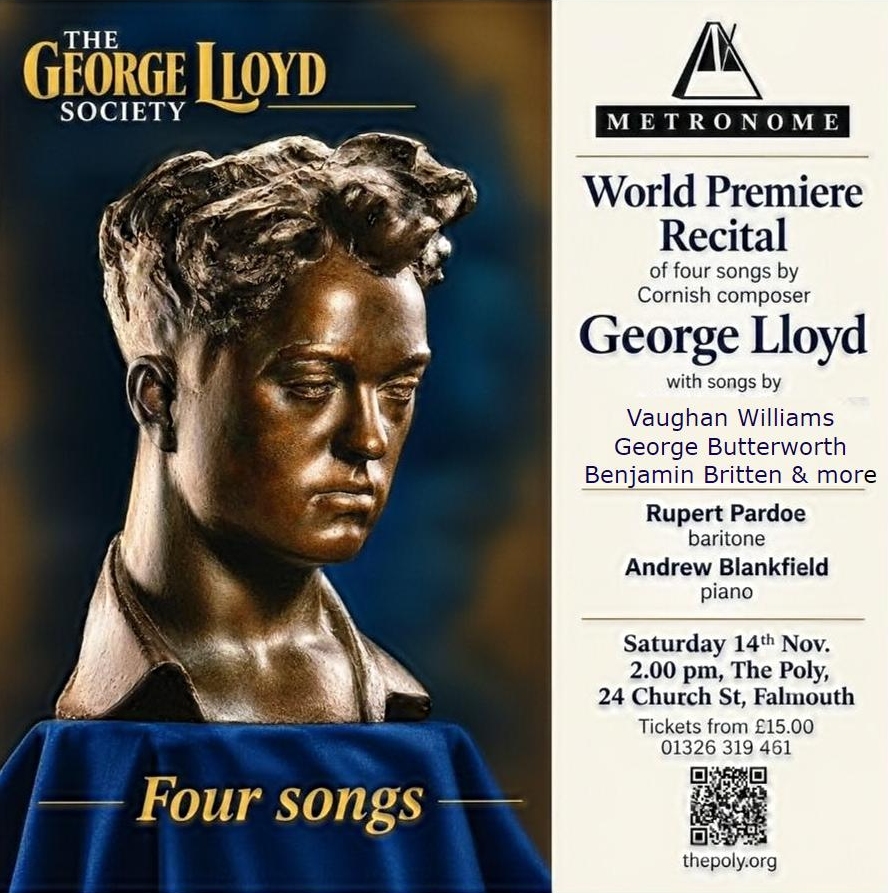
Four Songs: World Premiere in Falmouth
Journeys in Song Saturday 14 November 2026 2.00 pm, The Poly, Falmouth
Rupert Pardoe – baritone Andrew Blankfield – piano
Tickets £15, £10 and £5, Telephone: 01326 319461 Website: https://thepoly.org
|
| |
|---|
Four previously unpublished songs by George Lloyd are to receive their world premiere performance at a recital at The Poly, Falmouth, on Saturday 14 November 2026 at 2.00 pm.
The recital will be given by baritone Rupert Pardoe,
accompanied by pianist Andrew Blankfield.
Alongside the Lloyd songs, the programme includes works by Vaughan Williams, George Butterworth, Benjamin Britten and other composers.
The four songs, with Lyrita catalogue numbers, are:
• Wantage Bells – words by John Betjeman (SRMP0135) • Sea Grief – words by Douglas Hyde (SRMP0127) • We'll Go No More a Roving – words by Byron (SRMP0136) • Noon on the River – words by W. A. C. Lloyd (SRMP0124)
Although the four songs have only now come to publication, they each have their own particular history and associations.
|
|
|---|
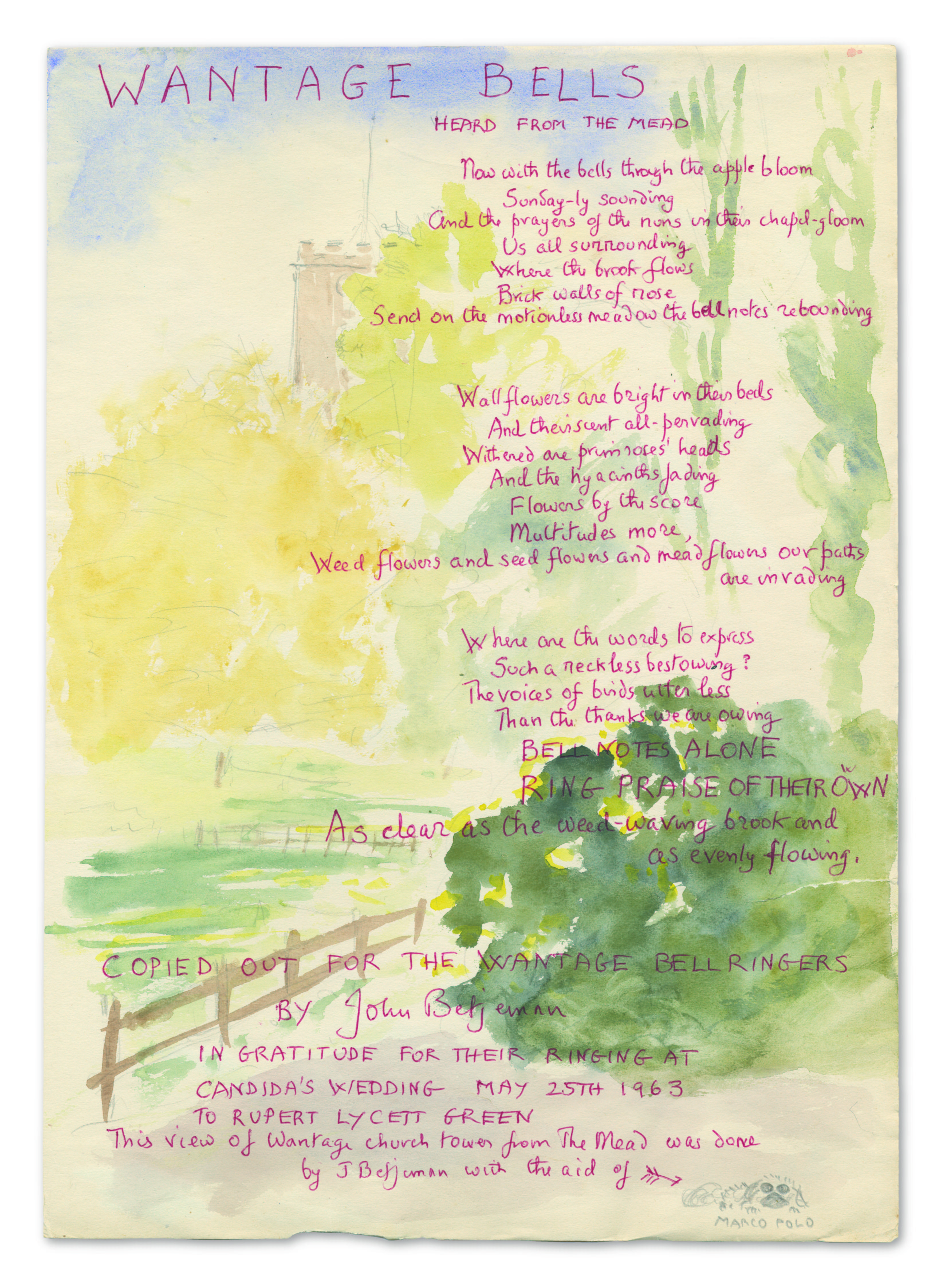
| Wantage Bells
by John Betjeman
Betjeman had a deep affection for Cornwall, and spent much of his later life at Trebetherick. He died there in 1984 and is buried at nearby St Enodoc Church, which he celebrated in his poetry.
Lloyd’s setting of Betjeman’s poem was commissioned by John G. Deacon of Conifer Records for the distinguished soprano Elizabeth Harwood.
The resulting recording, with John Constable at the piano, was issued on Conifer LP CFRA 120 as part of a recital of rare English songs. |
|
|---|
Both George and his father William were on first-name terms with Betjeman.
Research for Lloyd’s biography has uncovered documents relating to Grand Opera Productions Limited, the parent company of the Carl Rosa Opera Company, confirming that John Betjeman and William Lloyd were both directors. Betjeman was therefore privy to the intense structural debates surrounding state subsidies, the distribution of regional touring grants, and the political machinations of the Covent Garden management over funding for the Carl Rosa, who were producing Lloyd's opera John Socman.
At the height of these debates, which threatened the future of the opera, George spoke to Betjeman, who relayed some extraordinary information about the activities of Covent Garden, including allegations of a concerted campaign against the Carl Rosa and attempts to influence theatre bookings. That correspondence will
feature in the forthcoming biography of George Lloyd. |
| | 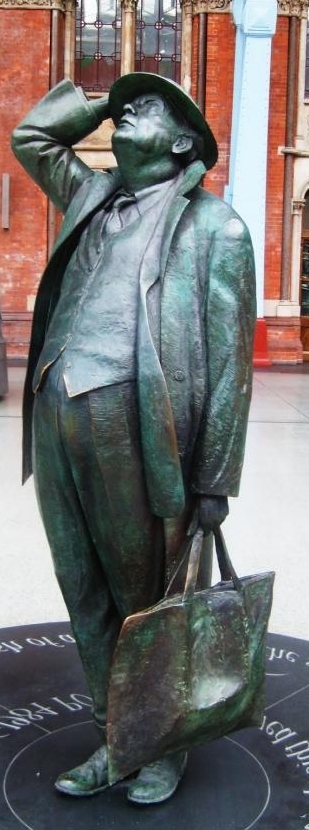 Sculpture of Sir John Betjeman,
St Pancras Station | |
|
|---|
The Society's website includes further information about the commission, together with the original recording.
Listen to Wantage Bells
(Society website) |
|
|
|---|
We'll Go No More a Roving by Lord Byron | | So, we'll go no more a roving So late into the night, Though the heart be still as loving, and the moon be still as bright. |
|
The song sets the well-known poem by George Gordon,
Lord Byron (1788–1824),
written in 1817 and included in a letter to his friend
Thomas Moore from Venice. |
|
|---|
Nothing is known of why
Lloyd chose to set the poem,
although he was known to wander on the Penwith moors by moonlight, and he was
familiar with the moonlight paintings of Julius Olsson.
George Lloyd's father William purchased Olsson's former house and studio, St Eia, and the composer’s earliest memories are of musical house concerts in that studio.
|
| 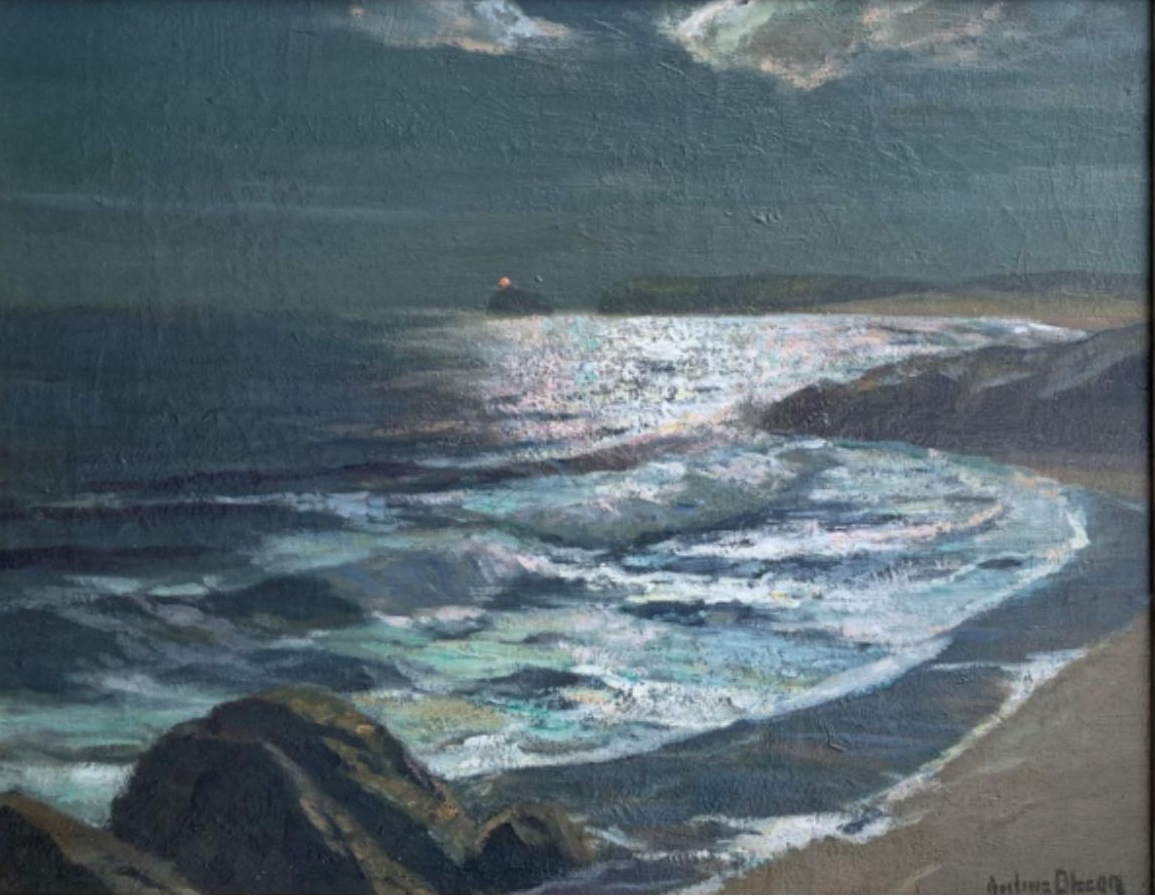 Julius Olsson:
Moonlight on St Ives bay |
|
|---|
The poem has attracted a number of musical settings.
Among English composers, Maude Valérie White (1855–1937) published a setting in 1888, while Thomas H. W. Armstrong
produced a choral setting in 1933.
Maude Valery White’s setting of ‘So we’ll go no more a roving’ (YouTube) |
|
|---|
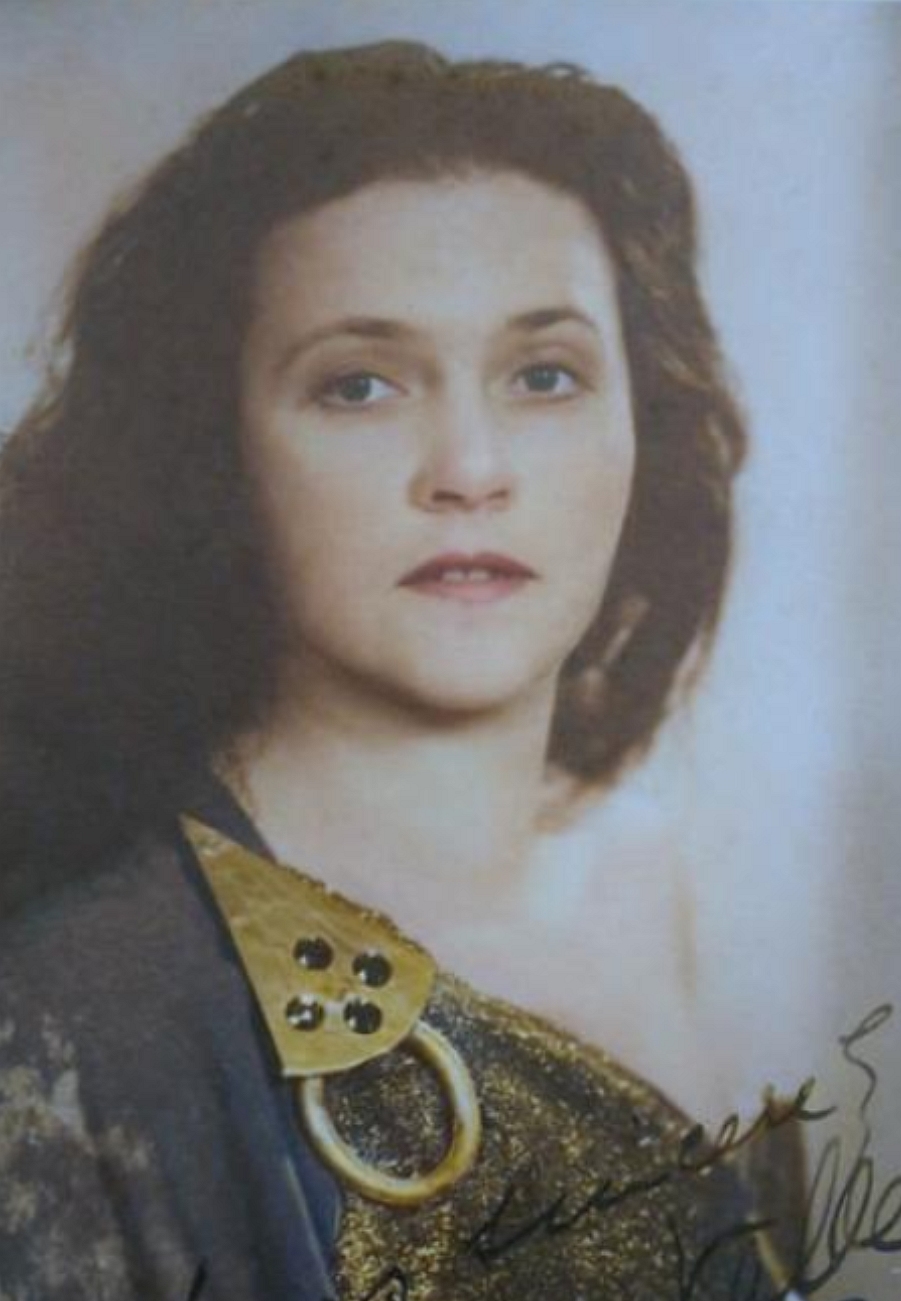 Gabriella Valle |
| Noon on the River
by W.A.C Lloyd.
The words to the song are by George Lloyd's father, William A. C. Lloyd (1885–1951), who wrote the librettos for all three of his son's operas.
The manuscript carries a personal dedication, dated Easter 1935:
"To Gabriella – would that this would be as good as it would need to be to be worthy of your singing."
|
|
|---|
'Gabriella' was soprano singer Gabriella (Gaby) Valle, who created the title role of the fairy heroine in George Lloyd's breakthrough Cornish opera Iernin. She was a principal high soprano of The Carl Rosa Opera Company, and went on to become a prominent singer all over Europe. At the time he set the song, Lloyd was rehearsing the opera for its transfer to the Lyceum Theatre in London. George later wrote that he was 'seduced by her voice.' |
|
|---|
Sea Grief by Douglas Hyde - an Irish connection.
Researching the background to Lloyd's setting of this poem has opened a door on to a relatively unexplored aspect of his biography. Sea Grief brings together three strands of the domestic, artistic and political environment in which the composer was raised, particularly the influence of his Irish ancestry.
The words to Sea Grief originate in an Irish folk song collected and translated into English by Douglas Hyde (1860–1949), scholar, writer and a leading figure in the revival of the Irish language, who later became the first President of Ireland.
Hyde recorded the song from an elderly Irish-speaking woman, Brighid Ní Corruaidh, in County Roscommon. It is a poignant lament by a woman separated from her beloved, with the
imagined prospect of travelling together on a ship bound for America. The song belongs to the wider history of Irish emigration during and after the Great Famine. |
|
|---|
Sea Grief - the family connection.
George Lloyd's mother, Constance, was half Irish, and had a lifelong interest in Irish culture and the Gaelic Revival. She learned to speak Irish and corresponded with Douglas Hyde, providing a direct family connection between the composer and the man whose translation he set to music. Their letters have now been donated to the National Museum of Ireland.
|
| 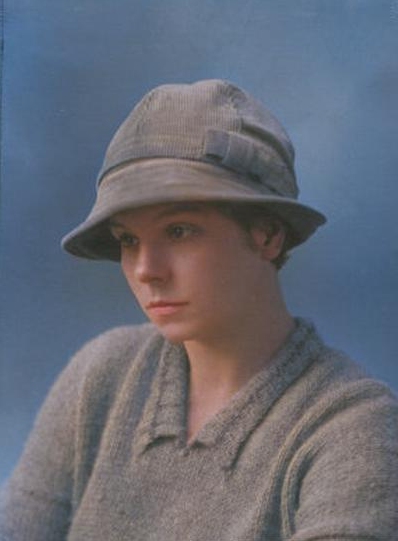 Constance Lloyd |
|
|---|
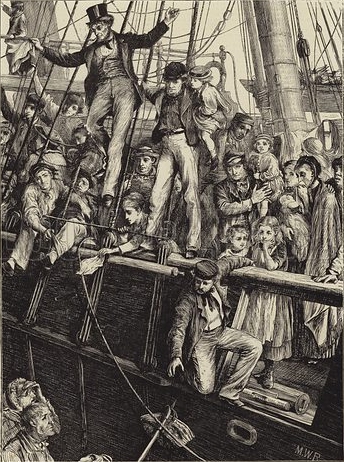 Leaving Old England |
|
Sea Grief Leaving Old England, 1869
by Matthew Ridley published in The Graphic, showing emigrants saying farewell to their loved ones as they leave for a new life overseas. Ridley was a friend of the Lloyd family, and presented them with the original modello – the preparatory drawing for this engraving, together with images of street musicians. The modello was found among George Lloyd's papers. |
|
|---|
The image has a particularly poignant relationship with the song: the separation of loved ones, the uncertain journey across the Atlantic and the hope of a different life elsewhere. It also provides a glimpse of the artistic connections surrounding the young composer and his family. |
|
|---|
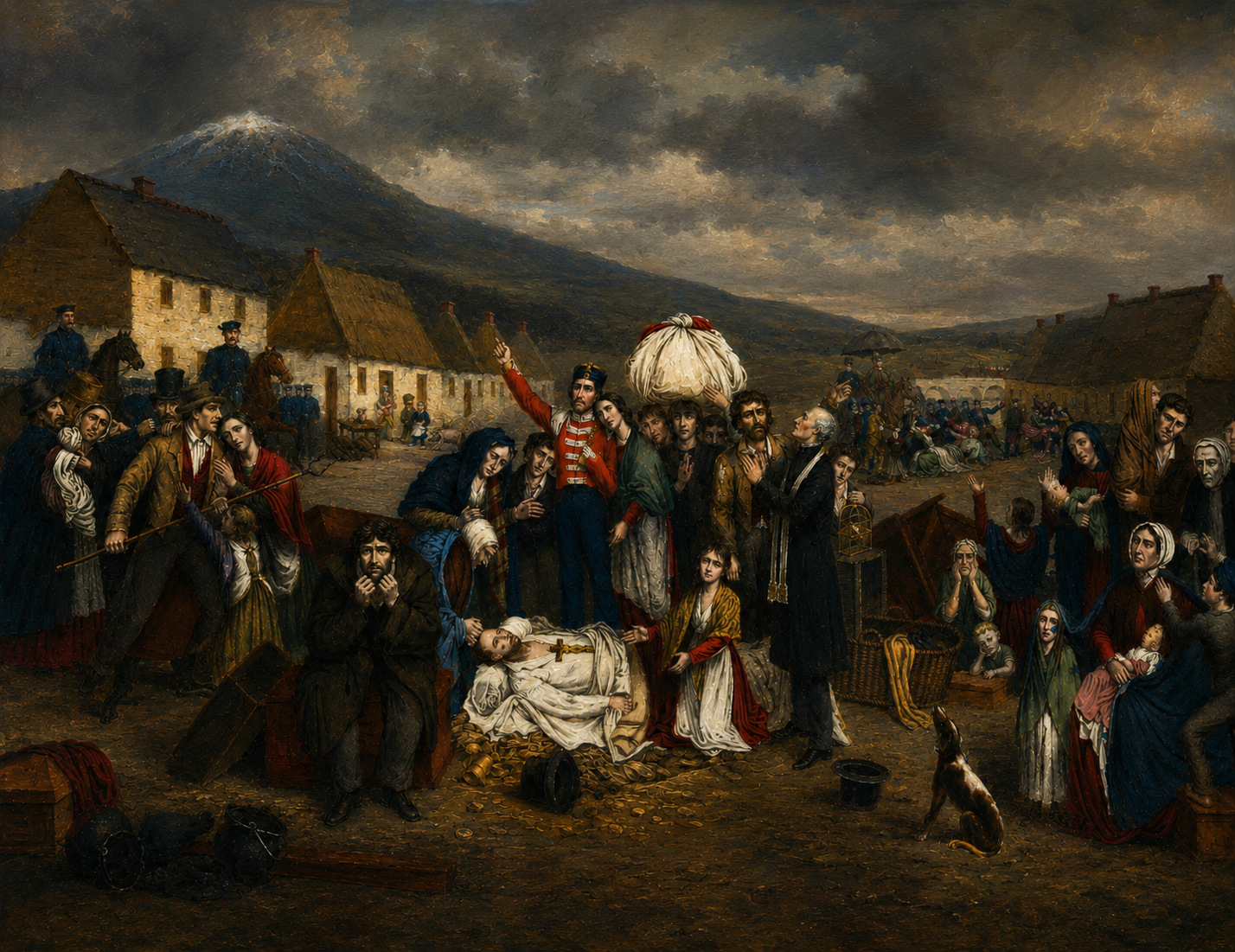 The Eviction by William Henry Powell |
| The Eviction
A further and more politically charged family connection emerges through George Lloyd's
paternal great-grandfather, the American painter W. H. Powell
(1823–1879).
|
|
|---|
Powell was known for his historical and narrative paintings,
including his mural The Discovery of the Mississippi by De Soto, for the Rotunda of the United States Capitol. In about 1871 he painted The Eviction, depicting Irish tenant families being forcibly removed from their homes. The image was reproduced as a lithographic print in New York in 1871 by Robison & Mooney. |
|
|---|
The print carries verses written expressly for the picture by Mary Jane O'Donovan Rossa (1845–1916), poet and political activist, and wife of the prominent Fenian leader Jeremiah O'Donovan Rossa. Her poetry and public activities in America were closely associated with the Irish nationalist movement, including efforts to raise support for imprisoned Fenians.
The picture is a powerful contemporary record of the Irish land question: the dispossession of tenant families, the destruction of their homes and the human consequences of eviction. Its accompanying poem gives the image an explicitly political voice. |
|
|---|
A Celtic inheritanceThese aspects of Sea Grief bring together two distinct strands of George Lloyd's family inheritance: on his mother's side, his Irish ancestry and Constance's close interest in the Gaelic Revival; on his father's side, the artistic legacy of his paternal great-grandfather, William Henry Powell, whose work also engaged directly with the political and social history of Ireland.
George Lloyd regarded himself as a Celt, and his Welsh, Irish and Cornish connections were fundamental to his sense of identity. Yet there is an intriguing paradox here. Much of his music, particularly the symphonies, has been described as distinctly English in character, and is frequently heard in that context.
How do these apparently contrasting identities sit together? Is the Englishness of the music at odds with the composer's own sense of his Celtic inheritance, or are the two less easily separated than they might first appear? |
|
|
|---|
Where Does the Music Come From?
The Paradox of George Lloyd's EnglishnessA forthcoming article in Spirited, the magazine of the English Music Festival. |
|
|---|
The music of George Lloyd is often described as being quintessentially English. Yet the composer himself identified strongly with his Celtic ancestry – Welsh, Irish and Cornish. Is there a contradiction here, or does his music reveal a more complex cultural identity? This article explores that apparent contradiction, beginning with the elusive and subjective nature of musical Englishness. |
| |
|---|
It considers how Lloyd's cosmopolitan upbringing, cultural environment and musical education shaped his work, including the influence of the violinist Albert Sammons and the composer John Ireland. |
|
|---|
|
The article focuses on Lloyd's distinctive two-stage approach to composition: his music first emerged through intuition and the subconscious, before being shaped by conscious thought, reflection and technical craftsmanship. |
|
|---|
The article suggests that, although Lloyd deliberately looked towards continental Europe, English cultural and musical sensibilities had become embedded in his imagination. His music could therefore sound English without his ever intending it to be so: not calculated nationalism, but culturally absorbed expression.
The article will appear in the next edition of Spirited, the magazine of the English Music Festival.
Further information about Sprited.
|
|
|
|---|
3. On the Air - Symphony No. 10, 'November Journeys' (1981)
Impressions and reflections whilst visiting some cathedrals.
Several radio stations have included Lloyd's Tenth Symphony in their November programming. Ross Amico, US radio host and producer of The Lost Chord, featured the work on WWFM The Classical Network. It was also broadcast by KWAX Classical Oregon and WXXI Classical 91.5. In the UK, BBC Radio 3 included one movement in its Sunday Morning programme on 1st November. |
|
|---|
The evocative subtitle of the 10th Symphony stems from a series of autumn railway trips Lloyd undertook across the UK to visit various cathedrals - inspired by his love of architecture and the availability of off-season rail fares. |
| 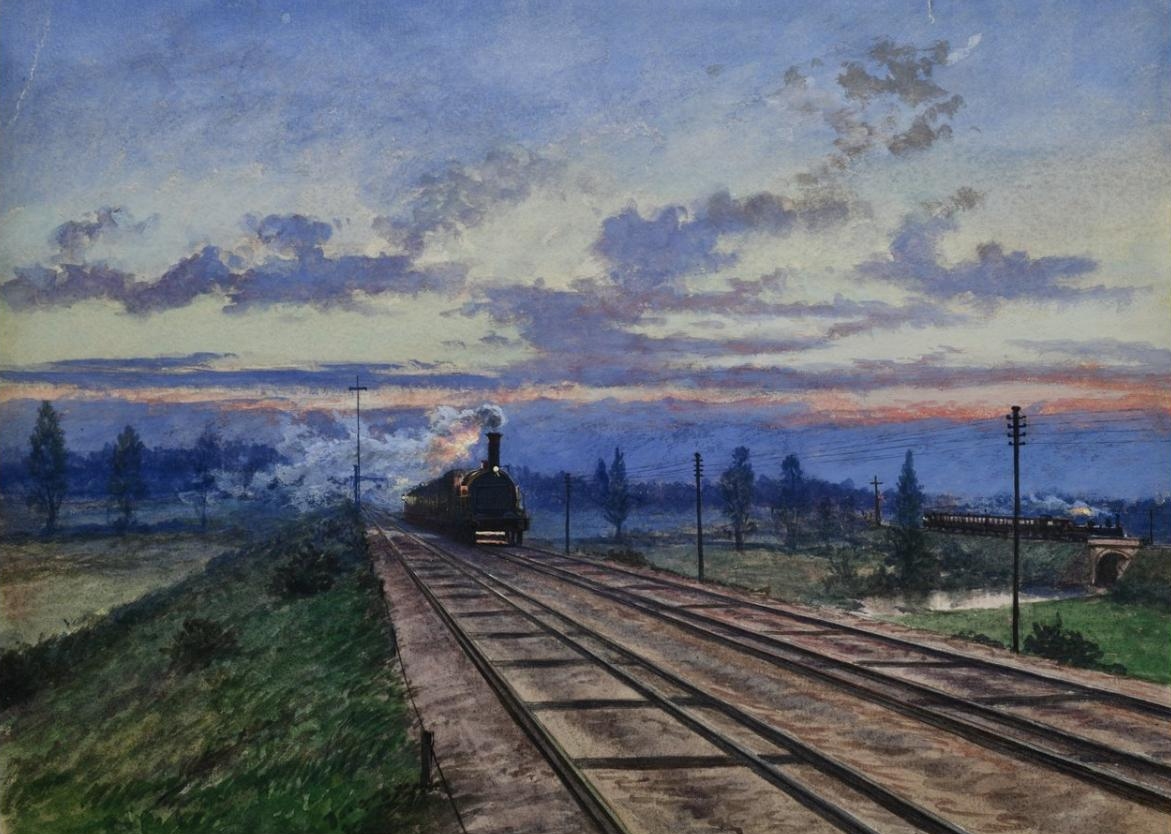 Artist unknown: English School |
|
|---|
As the composer travelled, the autumn colours and the soaring lines of English cathedral architecture began to fuse with his musical imagination. Lloyd later remarked:
“As I journeyed around the country, I kept on thinking of sounds for the brass, and these sounds became mixed up with the magnificent buildings I was seeing.”
The first performance was given in October 1982 at the Royal Northern College of Music (RNCM) in Manchester, performed by the Northern Brass Ensemble, (for whom it was commissioned by the BBC) conducted by Sir Edward Downes.
Following its successful Manchester launch, the work quickly travelled south, receiving its London premiere just a few months later in February 1983 by the London Collegiate Brass Ensemble.
The composer conducted his own recording of the work with the BBC Philharmonic Brass, now available on SRCD 2418, a box set of Symphonies 7 – 12.
Listen to November Journeys (Lyrita recording)
|
|
|
|---|
4. Looking Ahead to 2027Ealing Symphony Orchestra – Symphony No. 7 Proserpine |
|
|---|
John Gibbons and the Ealing Symphony Orchestra continue their ambitious project to perform all twelve of George Lloyd's symphonies.
The next performance in the series is Symphony No 7, subtitled Proserpine |
| …And all dead years draw thither, And all disastrous things; Dead dreams of days forsaken, Blind buds that snows have shaken, Wild leaves that winds have taken, Red strays of ruined springs Swinburne. |
|
|---|
Saturday 10 July 2027 St Barnabas Church, Ealing, London W5 1QG. |
|
|---|
Proserpine occupies a special place in Lloyd’s symphonic cycle. He began writing it in 1957, when his musical fortunes were at their lowest ebb. Following the commission and production of his opera John Socman for the Festival of Britain, he had hoped that his music would return to the mainstream, but that was not to be. His late Romantic, melodic style had fallen out of fashion, and performances and broadcasts of his music had dried up. It was clear that earning a living from composition was no longer a possibility, so he and his wife Nancy established a successful market garden in Dorset. Although he continued to compose, Lloyd had gradually given up hope that the BBC would continue the outstanding support it had given his
music in earlier years. |
| 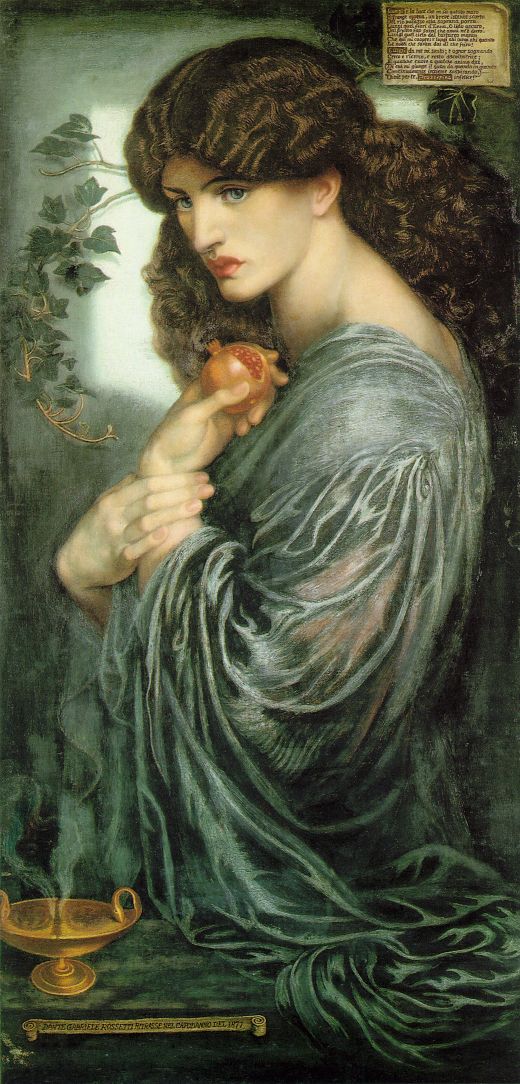 Rossetti: Proserpine |
|
|---|
The apparent collapse of his musical career, compounded by the continuing effects of his wartime experiences, brought him close to a breakdown. He later described the Seventh as the ‘deepest’ and most emotionally difficult of all his works. In an interview some thirty years later, he reflected that he had 'lost himself in the writing', and 'the music took him to places and emotional states he had never explored' so that he could not be sure whether the breakdown had caused the symphony, or the symphony had caused the breakdown.
| He took as his subject Proserpine, also known as Persephone, the Roman goddess of spring and vegetation, whose return from the underworld brings the renewal of life and the growth of crops. |
|
|---|
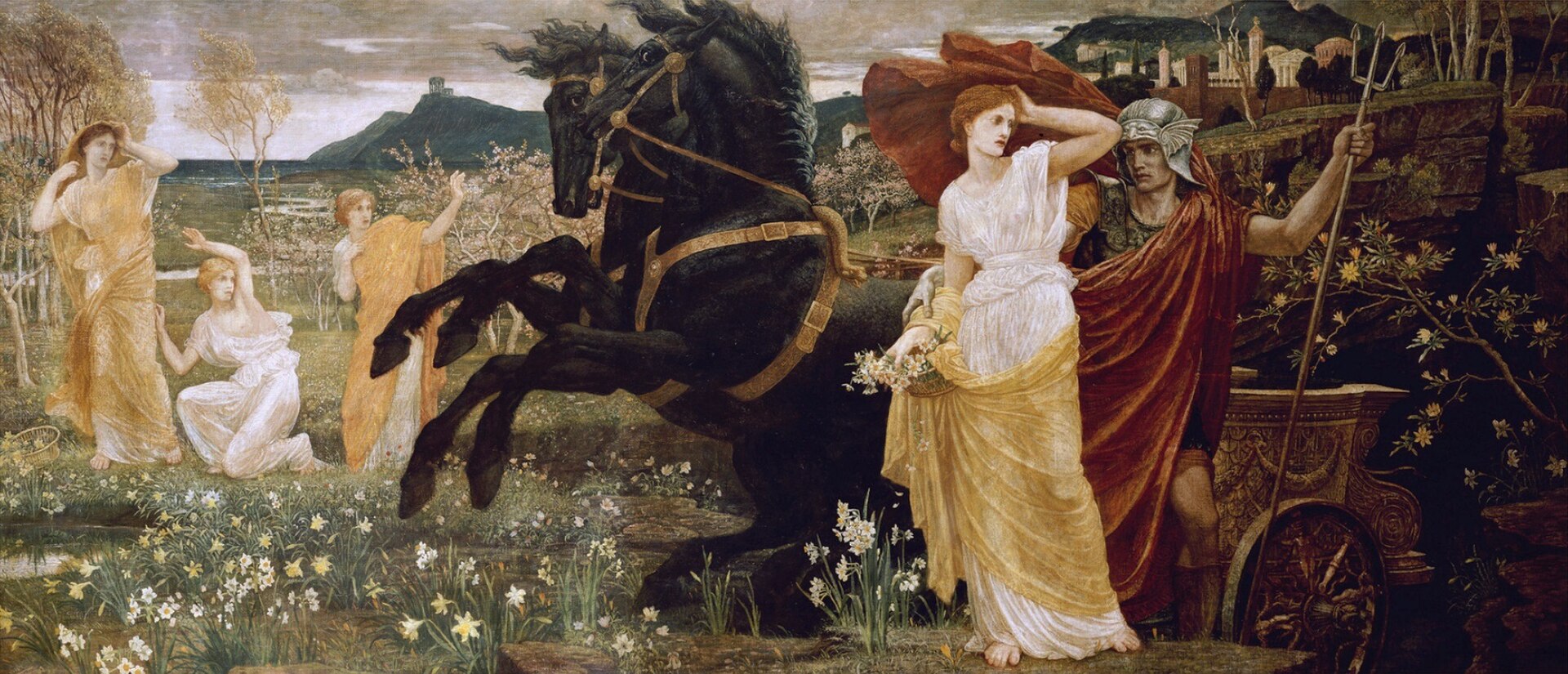 Walter Crane: Persephone (1877) |
|
|---|
Proserpine, a daughter of Ceres and Jupiter, was so beautiful that the father of the gods himself became enamoured of her. She made Sicily the place of her residence and delighted herself with the views, the flowery meadows and limpid streams which surround the plains of Enna. In this solitary retreat as she amused herself with her female attendants in gathering flowers, Pluto carried her away into the infernal regions, of which she became the queen.”
Lemprière’s Classical Dictionary |
| The three movements are prefaced by literary quotations: the first drawn from John Lemprière’s A Classical Dictionary, and the other two from Swinburne’s The Garden of Proserpine.
Through these texts, Lloyd created a symphonic poem that moves from the pastoral beauty of Proserpine’s garden, through her abduction by Pluto, to the darker and more disturbing imagery of the underworld. The result is a work in which the natural world, classical mythology and what appeared to Lloyd to be the end of his musical hopes are brought together.
LYRITA REAM1135:
BBC Northern Symphony Orchestra
Sir Edward Downes
LYRITA SRCD 2418,
Box set of Symphonies 7 – 12. |
|
|---|
| Thank you for reading thus far. We plan to continue providing these glimpses into George Lloyd's music, life and continuing legacy in future Newsletters. The archive is voluminous, and there is still much to discover, both in the music itself and in the collection of manuscripts, correspondence and family history that surrounds it.
As new performances, recordings and research bring different aspects of his work to light, we look forward to sharing them with you. In the meantime, thank you for your continued interest and support.
Please share this Newsletter with anyone you think may be interested.
with best wishes,
| |
|
|---|
The George Lloyd Society |
|
|---|
The George Lloyd Society - social media:
|
|
|---|
| |
 LinkedIn |
|
|---|
|
|